

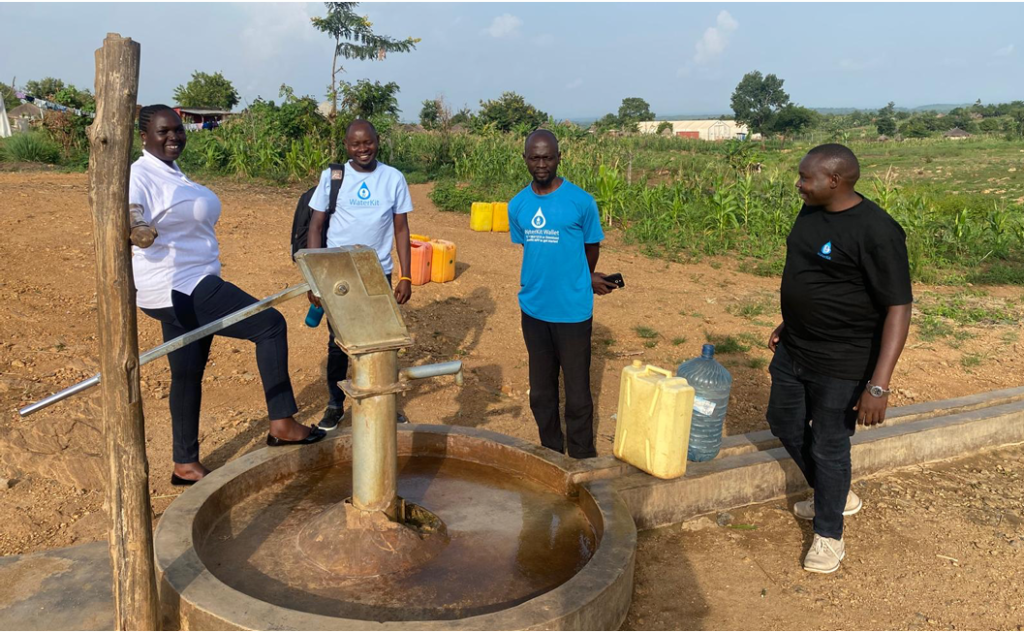
We enable communities sustain their water points using approapriate technologies and models. We are building Uganda’s leading solution for the Operation and Maintenance of rural handpumps through our WaterKit Wallet technology.
The WaterKit Solution
WaterKit does not build, own, or rehabilitate handpumps. Instead, it enables communities to sustain their own water points through a proprietary financial technology platform called WaterKitPay. The platform digitizes the entire handpump management value chain:
- User Fees Management: Communities collect household fees via the app, which are aggregated and held in a digital Water User Committee Wallet.
- Flexible Digital Payments: Repairs and maintenance are triggered digitally. Mechanics raise quotations, committees approve them, and payments are made via mobile money.
- Transparency & Trust: Every transaction leaves a digital footprint. Quarterly accountability reports are shared with water users, creating unprecedented transparency.
For preventative maintenance, WaterKit offers subscription services. For repairs, the process is simple: the mechanic quotes replacement parts, the committee approves, WaterKit procures the parts, and the repair is made. All fees are deducted from the community’s digital wallet.
About WaterKit
WaterKit is the only enterprise in Uganda operating a fully profitable, donor-independent service model for rural handpump maintenance. Founded by Denis Ogwang and incubated by Young Water Solutions in 2021, WaterKit has grown from a simple idea into a technology-driven business that currently serves 613 handpumps, providing reliable clean water to 200,000 people across Northern Uganda.
The Vision
WaterKit is enabling a future where every Ugandan handpump is sustained by its community. Through technology, transparency, and a profitable business model, WaterKit transforms broken, opaque water points into visible, accountable, and revenue-generating assets that deliver clean water for generations.
The Problem WaterKit Solves
Uganda has over 63,000 handpumps, and at least 67% of the rural population depends on them. However, one-third of these handpumps are dysfunctional at any given time. The root causes are systemic: low user fee collection due to lack of social pressure, non-transparent Water User Committees that foster corruption, weak community ownership, and high rural logistical costs that make repairs economically unviable. The result is insufficient revenue per handpump and chronic breakdowns.
The Business Model
WaterKit’s secret is what it does not do: no construction, no rehabilitation, no ownership. It only onboards functional handpumps with active Water User Committees. This lean approach allows WaterKit to operate profitably.
Current average profit is $35 per handpump per year, driven by collection efficiency (currently 92%, targeting 95%+), revenue per handpump ($163 annually), and geographic clustering to reduce field operations costs. At scale (6,000 handpumps), fixed costs per handpump will drop by over 50%, further boosting profitability.
Market Opportunity
Of the 63,000 handpumps in Uganda, approximately 42,000 are functional but poorly managed. WaterKit’s target market is 15,000 handpumps serving 4.5 million people. By 2030, WaterKit aims to serve 6,000 handpumps reaching 1.8 million people.
Scaling Strategy (2026–2030)
WaterKit will scale from 613 to 6,000 handpumps using four onboarding channels:
- NGO Partnerships (current main channel): NGOs handle community mobilization; WaterKit onboards at minimal cost (<$50 per handpump). Target: 200+ handpumps per year.
- Own Onboarding with Grants: Grant funding ($200 per handpump) enables direct marketing and rapid scaling. Target: 500+ handpumps per year.
- Cost-Sharing with Communities: Communities pay $100 down payment (50% of onboarding cost); WaterKit recovers the balance through user fees. Target: 100+ handpumps.
- ASP/O&M Integration: Partnering with government-contracted Area Service Providers to integrate WaterKitPay into the official framework. Target: 300+ handpumps.